
Vol. 3, Issue 2

U.S. Headquarters
Crystal McKenzie, Inc.
300 West 110th Street, Suite 4E
New York, NY 10026
v: 212-598-4567
e: contact@jinkwak.com
w: cminyc.com
CMI provides creative services for business and senior-level decision makers who proactively seek to deliver an exceptional key-stakeholder brand experience.
Referrals are the foundation of our business. Please share our contact information and/or a referral’s name with us. Thank You!
Cognitive Map for Wayfinding
Cognitive Mapping: Navigating the Mind
The process of cognitive mapping doesn’t happen overnight. It unfolds in distinct stages, much like how children and adults adapt to unfamiliar environments. Let’s delve into these stages in more detail:
Landmarks: Like a compass guiding our way, we first learn to recognize and associate prominent landmarks with our surroundings. These familiar objects serve as memory triggers as we navigate the streets. During this initial stage, children begin to construct a mental map by connecting these easily identifiable landmarks.
Route Mapping: The next stage entails viewing our neighborhood as an intricate network of interconnected routes, weaving together various points of interest. Over time, our mental routes not only connect landmarks to landmarks but also encompass places where we encounter new experiences or need to change our direction.
Survey Mapping: Finally, as our familiarity with the environment deepens, we develop a comprehensive mental blueprint of larger-scale surroundings. Our minds intuitively predict the direction to take, even when landmarks are hidden from sight. This advanced cognitive mapping is the result of accumulated knowledge, experience, and our innate ability to make accurate predictions.
When we mention ‘landmarks,’ we don’t solely refer to centuries-old churches or iconic structures. They can be seemingly insignificant objects such as a distinctive lamp post, a peculiarly shaped tree, or a local shop that stands out among the rest. While landmarks undoubtedly draw our attention, other elements like paths, edges, nodes, and districts also play a crucial role in shaping and maintaining our cognitive maps. As Kevin Lynch elaborates in his influential work ‘The Image of the City,’ these additional elements contribute to our spatial understanding and navigation abilities within urban environments.
Design Principles for Wayfinding
- Create an identity at each location, different from all others.
- Use landmarks to provide orientation cues and memorable locations.
- Create well-structured paths.
- Create regions of differing visual character.
- Don’t give the user too many choices in navigation.
- Use survey views. (give navigators a vista or map).
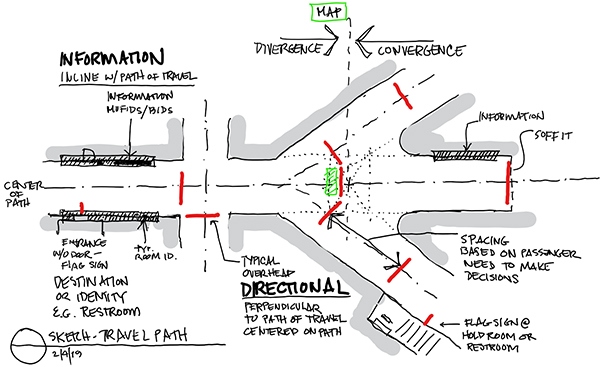
- Provide signs at decision points to help wayfinding decisions.
- Use sight lines to show what’s ahead.